Go to navigation Go to content
Toll-Free: 800-383-0331
Phone: 515-222-1110
Lombardi Law Firm

The Verdict - The Lombardi Law Firm Blog

Here at the Lombardi Law Firm we add blog content that is personal to those involved in accidents. We write this way so you have an understanding of how we think and handle cases - your case. We invite you to call us if you think we can help you resolve your legal problems. We settle most of our cases, because we do the basic legal work necessary to understand the facts of your case. We offer on our website, relevant and concise information that you will be helpful to you as you get ready to settle or to try your case. 

We can and will do the same for you. That's my promise. So call us today!

Steve Lombardi, 515-222-1110 or sdlombardi@aol.com 


6/23/2009
Todd Miler
Comments (0)

OWI: Iowa Corn Indy 250 Fans

The Iowa Speedway has been an economic boom for the City of Newton, Iowa.  And here comes the Iowa Corn Indy 250 which will be the boom for the local law enforcement to fill their annual budget.  This means arrests for anyone seen in public who resembles a drinker of alcohol.  Fines will be levied and assessments made for "room and board" for jail sentences.  I expect the arrests will largely be for OWI, which is also known as DUI or drunk driving, interference with official acts, assault on a peace officer, and public intoxication.  Even if you haven't been drinking, officers' reports will indicate a strong smell of alcohol, bloodshot watery eyes and slurred speech- only the names will be changed.  In my experience with these types of events, local law enforcement will have virtually all hands on duty.  Most officers will not have the time or the temperament to properly handle each case, which means that some steps in proper protocol will be overlooked.  To a lawyer, this means that constitutional rights will be violated.
 
The City of
Newton sits on an interstate, I-80.  There are other highways; such has State Highway 14 that leads to Newton.  There will be city police officers, county sheriff's deputies, and state troopers all over.  They won't be concerned about Helio Castroneves, Danica Patrick or Dan Wheldon.  They will have their own competition of sorts on arrests.
 
Any guest visiting our state should know that if arrested you do have a right to call a lawyer or family member in order to secure a lawyer once you arrive at the jail in order to protect your rights.  Otherwise, be responsible and enjoy yourself.  Maybe you'll even get to have a Budweiser in the parking lot.


Category: Keyword Search: DWI

5/4/2009
Todd Miler
Comments (0)

OWI: Maintaining Silence

How do you maintain your silence when they are asking your questions?  An officer has to honor your request to talk to a lawyer and to remain silent.  That is your constitutional right.  You have the right under the 5th Amendment to not be a witness against yourself, and you have the right under the 6th Amendment to the assistance of counsel.  Be prepared however since the officer is not going to take your silence as a friendly gesture.  Some officers view silence as an admission of guilt.  Many officers view the constitution as an obstruction to justice and some have the view that the “end justifies the means.”  Those officers do not care if you’re constitutional rights are violated.  They do not like it when people do not respect their authority and refuse to answer their questions.  They threaten to file additional charges, such as Interference with Official Acts for refusing to answer their questions.  Even if you do not answer their questions and do not take their “tests”, they will still charge you with OWI.  If you have decided, either on your own or through the advice of an attorney, to remain silent then you need to stick to your guns.  If you initially decide to remain silent, which then draws the officer’s anger, and you decide to talk about your charge, you are then in the worst situation which is making statements about your charge in additional to having an angry cop.  Most officers will honor your request and fill out their paperwork as long as you sit quietly.  If you do initially indicate that you are going to remain silent, you can not decide to ask questions and expect the officer to talk to you.  All of your questions should go to your lawyer, not the officer.


Category: Keyword Search: DWI

5/4/2009
Todd Miler
Comments (0)

OWI: Promises of leniency or that you won't be arrested

What if the officer promises you that you’ll get off easy or that he won’t tell anyone?  The law says that police officers can lie when investigating criminal activity.  There is simply no way for me to ever count how many cases involve officers telling someone that they won’t be charged if they just come clean or admit they did something.  Often times, upon hearing that assurance, people will say just about anything in order to end their encounter with an officer, expecting to go free.  Unfortunately that is usually just the beginning of the legal process.  The officer will then take that statement and use it against the person.  Words out of your own mouth tend to be the most damning evidence, even if you are innocent.  The officer is not the ultimate charging authority, which is the job of the prosecutor.  The prosecutor does not have to honor any promise or assurance that the officer has made to you.


Category: Keyword Search: DWI

5/4/2009
Nick Lombardi
Comments (0)

OWI: Investigative Techniques used by law enforcement

What are some of the “investigative techniques” that officers use?  There are a handful of techniques that officers use to gain evidence.  First, they often will follow a vehicle for an extended period of time to observe driving behavior.  For example, the officer is going to count how many times your tires touched the center line, or that you were “weaving within your own lane.“  After stopping your vehicle, and upon their initial approach to your vehicle, they are going to stand at your window and see what they can see, smell what they can smell, and hear what they can hear.  If they see anything that has the potential to be evidence, they are going to want to examine it.  This can mean something as obvious as open beer cans, to as subtle as a pack of cigarettes.  They are going to watch your every move while you are search for your license, registration and insurance.  The officer’s report will ultimately say that you were “fumbling around” looking for those things.  The report will also indicate “an odor of alcoholic beverage coming from within the vehicle.“  These are common phrases included in most reports.  You will next be asked to sit in the officer’s vehicle.  This helps the officer in many ways.  The officer can sit and chat with you while he’s filling out your traffic citation.  He is going to try to get you to admit you had a beer prior to driving.  If you have a passenger in your vehicle, the officer is then going to go up and ask the passenger the same questions and look for any discrepancies in the stories.  Often times, the officer will tell the passenger that the driver said things, when in fact the driver said no such things.  In this day and age, most law enforcement vehicles are equipped with video and audio capability and will capture the entire encounter.  Sometimes an officer will turn off his microphone so that he does not record what is said.  Eventually you will end up in front of his vehicle performing physical exercises and the officer will say that he could tell you were intoxicated by how you performed those exercises.


Category: Keyword Search: DWI

5/4/2009
Todd Miler
Comments (0)

OWI: Who decides if charges will be filed?

Who decides whether someone should be charged with OWI?  Normally an officer on the scene of the traffic stop will make that determination.  That officer is the person who observes the driving and the behavior at the scene and ultimately requests a sample for blood alcohol analysis.  The arresting officer is often times the only witness the State uses in an OWI prosecution.  Before they finish their training to become a police officer, all officers are taught  the necessary testimony to obtain an OWI conviction.  In some cases, an officer does not make the final charging decision and will request that a prosecutor review the evidence.  Even if the officer told the driver that they were not going to be charged with OWI, the prosecutor can file the charge.  In every case, the prosecutor has the ultimate decision on whether to proceed with a charge and pursue it in court.


Category: Keyword Search: DWI

5/4/2009
Todd Miler
Comments (0)

OWI: Why do some charges get dismissed?

What are some of the reasons that OWI charges get dismissed?  In the final analysis, the reason any case gets dismissed is due to a lack of evidence.  This means that either the State doesn’t have enough evidence, or the evidence they obtained was obtained in violation of the law.  Your case should never get to trial if the officer did not do his job correctly.  Most of the time the officer fails in some respect- the question becomes how important was that failure.  The key to most acquittals is that the client gets to a lawyer’s office almost immediately after arrest.  A dismissal is usually due to one or more of the following: an improper stop of the motorist, an improper search of the vehicle, inaccurate breath testing, failure of the government to meet deadlines, violation of constitutional rights such as Miranda, independent witnesses to counter the officer’s testimony, or lack of proper cause to arrest.


Category: Keyword Search: DWI

5/4/2009
Todd Miler
Comments (0)

OWI: When should you refuse the breath test?

When should you refuse the breath test?  This is a very difficult decision.  There is no universal answer applicable to all persons.  When a person provides a breath test and is over the legal limit, they are going to have their driver’s license suspended.  The length of the suspension depends upon whether this is a first, second or multiple offenses.  A person may be eligible to obtain a work permit prior to the end of the suspension.  If a person refuses to provide a breath sample, however, the length of the suspension is going to be much longer.  Any person who is employed or needs to travel by vehicle for any reasons is going to have to make the difficult decision.  You do have the right to consult with an attorney prior to making this decision at the police station.  If you request to talk to an attorney prior to providing a breath sample, the officer has to honor your request, otherwise your license cannot be suspended and they cannot use the breath test, or lack thereof, against you in court.


Category: Keyword Search: DWI

5/4/2009
Todd Miler
Comments (0)

OWI: How long does a person lose their license when arrested for OWI?

How long does a person lose their license when arrested for OWI?  Being charged with OWI is a very serious crime in IowaIf convicted, you will lose many rights, privileges, liberties and a considerable sum of money.  This means jail time, several thousand dollars, the inability to drive for a considerable period of time which will potentially cost you your job, and additional freedoms while on probation such as the ability to enter a restaurant for at least one year, or to have to get permission from your probation officer to leave your county of residence on each occasion.  You will also lose your hunting privileges, among other things.  Often times, losing your driver’s license is the most serious of these consequences.  The length of any drivers’ license suspension and eligibility for a work permit should be examined by an attorney.  Factors such as whether a breath test was performed, the level of blood alcohol concentration, whether there was an accident, the existence of any prior convictions, and the sentence given by a judge will all influence the length of suspension.  The sentencing judge also has some discretion on the amount of the fine and the jail sentence imposed.


Category: Keyword Search: DWI

5/4/2009
Todd Miler
Comments (0)

OWI: What is a field sobriety test?

What is a field sobriety test?  In the 1970s, the National Highway Traffic Safety Administration developed some physical exercises that they believed were reliable indicators of alcohol intoxication.  In Iowa, officers primarily use three of these tests: horizontal gaze nystagmus (HGN), walk and turn, and one-leg stand.  Each of these tests is alleged to be a reliable indicator of intoxication, for example, the NHTSA claims the HGN by itself is 77% accurate, the Walk-and-Turn by itself is 68% accurate, and the One-Legged Stand by itself is 65% accurate.  These tests are problematic however.  One of the strict requirements of these “tests” is that the officer has no discretion in the manner in which the tests are to be performed.  In other words, in order for the test to have any meaning, it must be done exactly in the manner in which it was designed.  The authors of these tests specifically state in their training manual:

“IT IS NECESSARY TO EMPHASIZE THIS VALIDATION APPLIES ONLY WHEN: THE TESTS ARE PERFORMED IN THE PRESCRIBED, STANDARDIZED MANNER THE STANDARDIZED CLUES ARE USED TO ASSESS THE SUSPECTS PERFORMANCE THE STANDARDIZED CRITERIA ARE EMPLOYED TO INTERPRET THAT PERFORMANCE IF ANY ONE OF THE STANDARDIZED FIELD SOBRIETY TEST  ELEMENTS IS CHANGED, THE VALIDITY IS COMPROMISED.”

Officers very rarely perform the HGN in the manner required.  Another problem with the HGN is that there are dozens of things which cause nystagmus, not just alcohol.  And, moreover, there are dozens of types of nystagmus.  The Walk and Turn and One Leg Stand tests are difficult to be performed even by sober, athletic people in the best of circumstances on well lit, flat and dry surfaces free from debris.  These tests have been termed “divided attention tests”, and the officer is going to be looking not only at your physical behavior but how well you listened to the instructions to the test, assuming he gives proper instruction.  For example, at the beginning of the walk and turn he is going to say “don’t start until I tell you to start.”  He is then going to put one foot in front of the other and stand that way while he describes and demonstrates the test.  Most people are going to copy his behavior by placing one foot in front of the other at the same time he does it- his report will indicate that you are exhibiting signs of intoxication.  This is instinctual behavior, not realizing that you are being “graded” on this activity.  This one instance is just one example of the problems with these “tests.”  There has been additional study performed since the NHTSA developed these tests and they can be shown to be nothing more than impossible exercises designed for you to fail.


Category: Keyword Search: DWI

5/4/2009
Todd Miler
Comments (0)

What is the legal limit in Iowa for blood alcohol concentration?

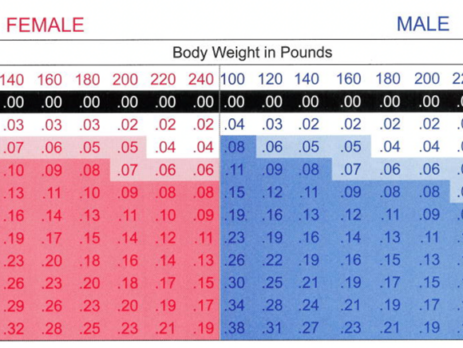
What is the legal limit in Iowa for blood alcohol concentration?  A prosecutor has two options when charging someone with OWI: either their blood alcohol level is over .08 or they are “under the influence.”  In some cases, a person has either elected not to provide a sample for the government to analyze or they have tested below .08.  In those cases, the police officer will attempt to obtain other evidence in order to attempt to prove that someone is “under the influence.”  This is the reason that I put the term “legal limit” inside quotations since there really isn’t a “legal limit” in Iowa.    The .08 law is known as the “per se” law.  This means that if you provide a test over .08, you are considered to be in violation of the law.   But even if you are below .08 you can be found guilty of operating while under the influence.  And even if you are over .08, there are a number of reasons why you may be innocent.  Some of these reasons may include the time that has elapsed between driving and the breath test, the device used to measure the breath sample, the health of the individual, or the manner in which the officer obtained the breath, blood or urine specimen.


Category: Keyword Search: DWI

4/2/2009
Todd Miler
Comments (0)

OWI, DWI, DUI, OMVUI or just Drunk Driving - KNOWING YOUR RIGHTS

You are innocent and charged with OWI (In Iowa, this stands for Operating While Intoxicated.  Some states use the terms DUI, Driving Under the Influence, or DWI, Driving While Intoxicated).  You should either get a dismissal of the charge before a trial, or a unanimous jury verdict at trial of “not guilty” which in legal terms is called an acquittal.  I’ve had jury acquittals on breath tests as high as .185, which is more than twice the legal limit, and on breath tests as low as .06, which is less than the “legal limit” of .08.  Yes, sometimes, prosecutors will file an OWI charge even if you blow less than .08.  And yes, the law allows them to do that in their all powerful discretion.  A prosecutor has two options for charging someone with OWI: either their blood alcohol level is over .08 or they are “under the influence.”  In some cases, a person has either elected not to provide a sample for the government to analyze or they have tested below .08.  In those cases, the police officer will attempt to obtain other evidence in order to attempt to prove that someone is “under the influence.”  This is the reason that I put the term minimum “legal limit” inside quotations since there really isn’t a “legal limit” in Iowa.  In upcoming blogs, I will answer the questions that are often raised in an OWI case, such as:

 SUBJECTS I WILL COVER:

 What is the “legal limit” in Iowa for blood alcohol concentration?
 What are the different ways that blood alcohol content can be measured?
 What five things should you not do upon being stopped?
 Why does the officer ask if I’ve been drinking?
 How do you maintain your silence when they are asking your questions?
 What if the officer promises you that you’ll get off easy or that he won’t tell anyone?
 What are some “investigative techniques” officers use?
 Who decides whether someone should be charged with OWI?
 What are some of the reasons that OWI charges get dismissed?
 When should you refuse the breath test?
 How long does a person lose their license when arrested for OWI?
 What is a field sobriety test?
 I’m drunk and at a bar, what do I do?
What is MADD?

PASSING THE FIELD SOBRIETY TEST


Category: Keyword Search: DWI